
#12: Re-imagining societies and building movements

Hello friend,
I have spent the past weeks re-watching old movies that influenced me in younger age. From Schindler's List to Ghandi, and The Pianist. As a teenager, movies like these were the window for my interest in societal change. I learned about civil disobedience (without knowing the term), about the importance of ethics and morals (without having read any philosophy) and the role of brave leaders (who taught me that it is difficult to create change, that change is uncomfortable). In fact, I was quite obsessed about leaders who led movements.
For instance, my fascination with Nelson Mandela began at the age of 13 - and as a "fan girl" I even ended up creating silver necklaces and t-shirts with his nickname Madiba, read anything I could get a hold on about the anti-apartheid movement - and was in total awe on the approach for reconciliation of the South African people. I know today that every movement and every human is complex - mistakes are made, values shift and reality is much, much harsher than what the theory book sets out to do. Nevertheless, I began to re-watch movies that triggered my being to work for the social good to remind myself to stay put and revaluate what "impact" means to me. Today I hope to share 3 snippets on ideas that have influenced my own world-view:

Emergent Strategy - Shaping Change, Shaping Worlds by adrienne maree brown
What: This is THE book to read on transformation of societies, facilitation of change, mobilisation through care and love, liberation of masses and reflections on contemporary society. This book holds no boundaries to explain the complex realities of today - it moves from science fiction imagination of the future society and equality, to quoting Rihanna and Beyonce, to speak of pleasure and activism and concrete tips on how to bring groups together. Emergent Strategy is beyond extraordinary - and one of the best books I have ever read. It is uncomfortable, unconventional, eye-opening and exact what we need to hear, see and feel as societies in the West.
Why it matters to me: adrienne maree brown's book literally gave me a much needed cold shower last year! It brought me out of my ego and opened up my eyes to a wider, more colourful and emerging World. I stumbled upon this book when I was researching on biomimicry, as she refers to elements of biomimicry in justice movements (!), and what I gained was much bigger. This book brought me back to my core values, demanded from me to be bigger and let go to let in. I cannot make justice to this book with only a few lines - but I do hope I convey my enthusiasm to you and that you go and get it, read it and share with me your experience with it!
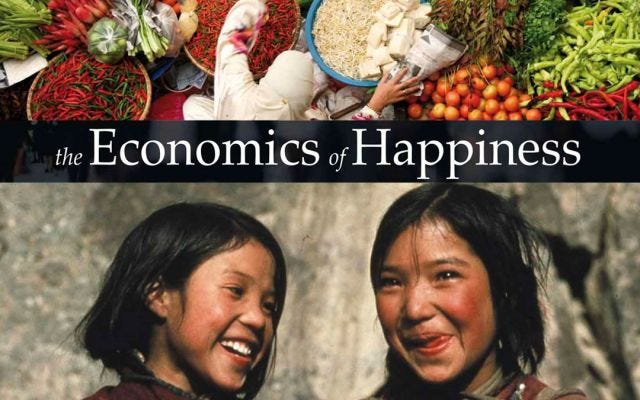
What: The Economics of Happiness is a documentary from 2011, but remains as relevant as it was then as today. The documentary showcases the two directions of global economic expansion: on one hand the forces behind big companies and politics - and on the other hand the resistance and movements by civil society. The documentary brings forward voices on alternative directions of our society, that is not filled with destruction, mass-expansion and profit-fetichism. Instead, The Economics of Happiness shows us how local, smaller scale economies can (and are!) thrive and how other societies can begin to imagine other forms of societal structures.
Why it matters to me: I saw this documentary when it was released almost a decade ago, and have kept its message close to my heart in regards to new paradigms and critical thinking of today's economic globalisation. I am by no mean an economist, but having worked closely with civil society for many years I am totally convinced that the power lays in communities - which can link across borders, but not for the sake of profit and power. Check this documentary out, the link gives you free access to the full version.
Henry David Thoreau - and other transcendental thinkers
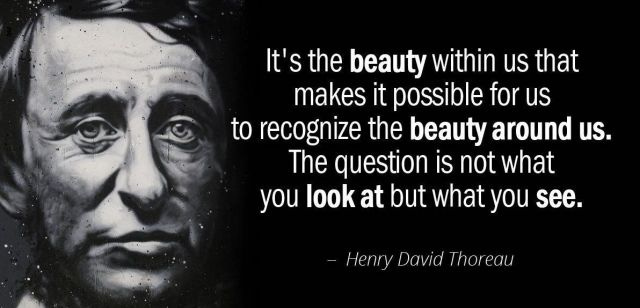
What: "I went to the woods because I wished to live deliberately, to front only the essential facts of life, and see if I could not learn what it had to teach and not, when I come to die, discover that I had not lived." Henry David Thoreau belongs to the transcendentalistic philosophical movement, which developed in late 1820's in the United States. Alongside Thoreau this philosophical school of thought also welcomes great thinkers such as Ralph Waldo Emerson, Walt Whitman (you may recall Whitman's poem being recited in Dead Poet's Society) among other. The core of Thoreau's, and other transcedentalists thinkers, is the reflection of the goodness of humans, the embrace of nature, and the self-reliant and independent living.
Why it matters to me: I only discovered the depths of thinkers like Thoreau, Whitman and Emerson during my grad school. But the impact those, and other in the same field, has had on me is tremendous. I dare to say it was through their civil courage, disobedience and choices in life that I truly began to question the status quo of our own society and the personal role in it. The joy of reading these thinkers morals ideas and actions cannot be underestimated. Beautifully crafted descriptions of the meaning of live and the importance of standing true to it. Indulge in Thoreau, Emerson and Whitman and grow as a human being.
Love,
Nathalie

Did you know...
... flocks of bird, no matter the size of the flock, are never led by one single bird. Instead, the flock is the result of a collective movement of sensing each others change of direction. This sort of swarm intelligence enables birds to decentralise and self-organise themselves as one entity.